Sikku Kolam - 29
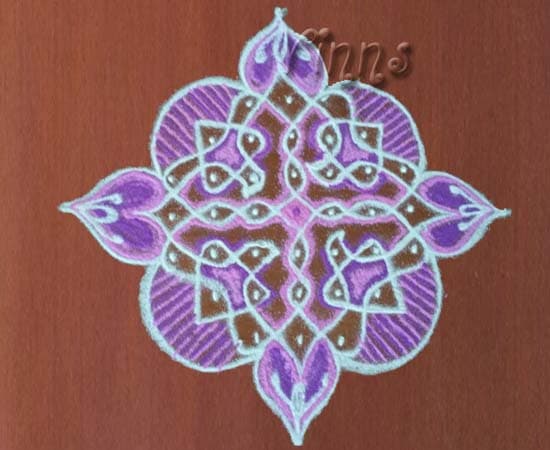
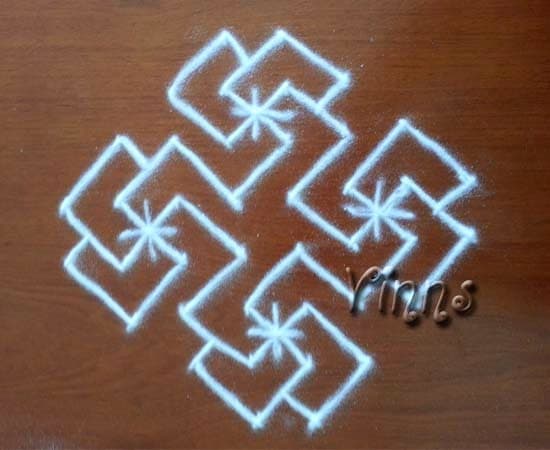
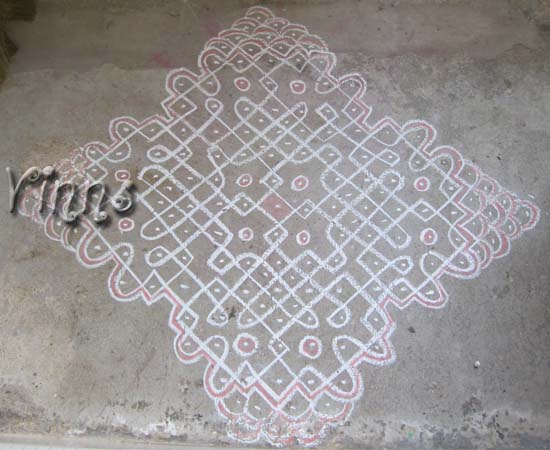
An easy kolam though may look difficult. It has many individual strands mostly rectangle shapes and its easy to draw without any hassles. I tried to give an uplift to this simple kolam but that gave.
An easy kolam though may look difficult. It has many individual strands mostly rectangle shapes and its easy to draw without any hassles. I tried to give an uplift to this simple kolam but that gave a reverse effect. Dot count: 13x5-12-7x2-5 in a straight pattern.
I'm planning to draw this kolam again and upload in this page.
Lay the 13×5 Straight Grid
Sprinkle a few drops of water on the threshold. Place the 13×5 Straight Grid (Ner Pulli) with even spacing using white rice flour or chalk, ensuring interlaced dots sit nested diagonally between adjacent rows.
Start with the Central Core Loop
Locate the central anchor dots. Loop a fluid, continuous curve encircling the inner dots to establish the foundation of the design. Beginning at the center ensures balanced 4-fold symmetry.
Weave Around the Outer Dots
Pinch dry rice powder between your thumb and forefinger. Guide continuous, flowing waves threading between and around the perimeter dots without lifting your fingers or stopping mid-turn.
Connect the Final Loops & Add Kaavi
Connect the outer curves smoothly back into the starting loop so all lines merge into complete, closed loops. Frame the outer corners with traditional red Kaavi (red ochre) border for clean contrast.
Related Traditional Patterns
Similar geometries, symmetry types, and festive floor art styles