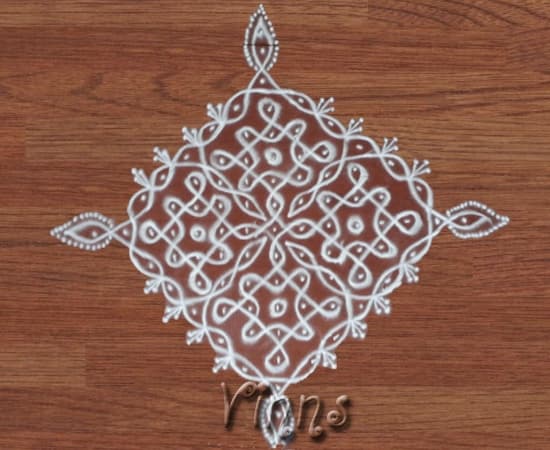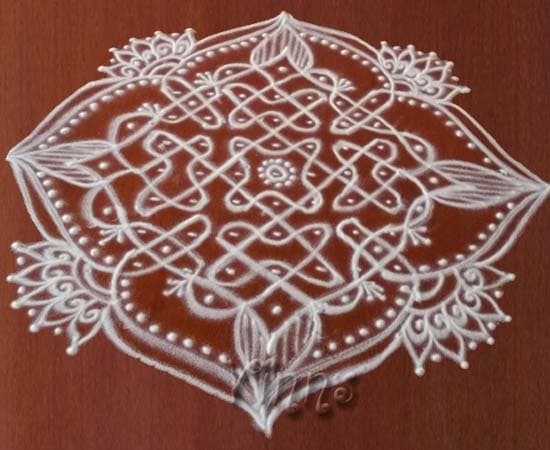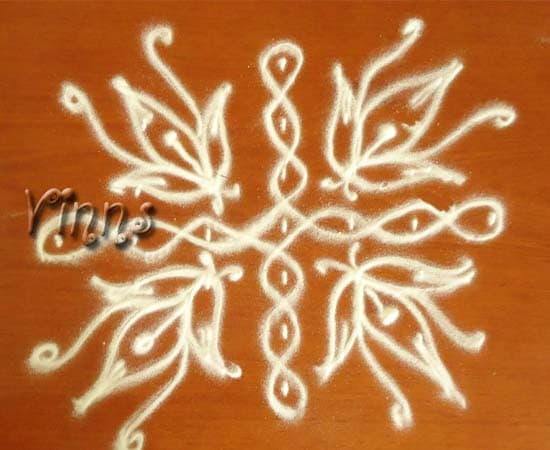
Sikku Kolam
An ancient geometry of continuous closed loops woven harmoniously around grid dots without broken ends.
The Eternal Knot: Continuous Loop Geometry
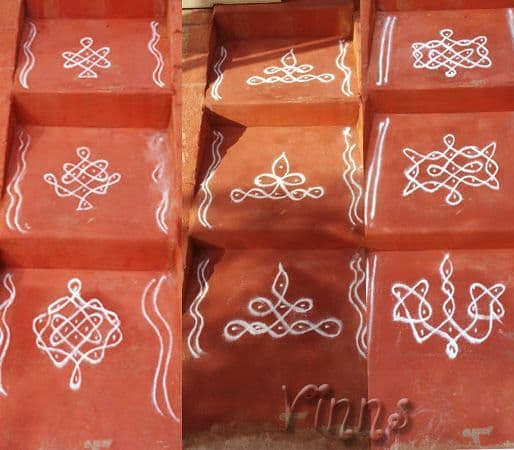
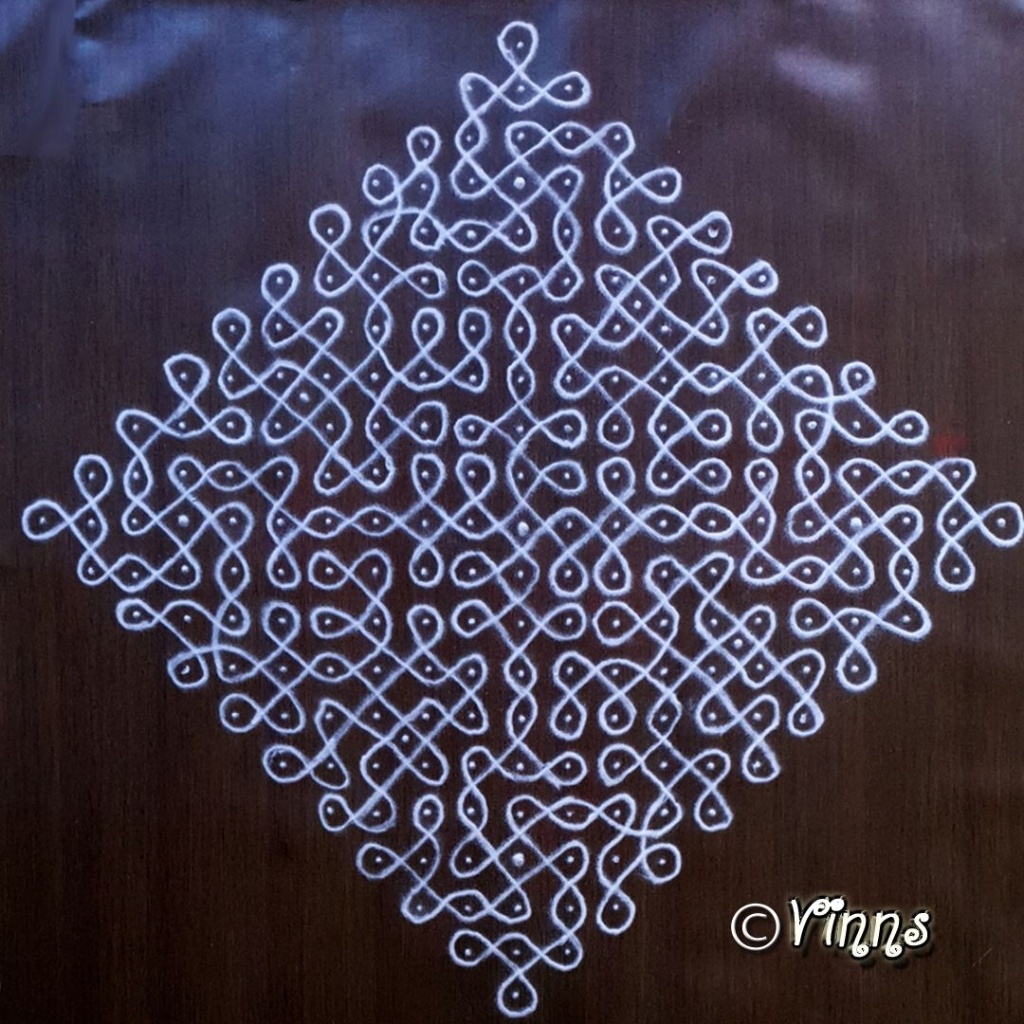
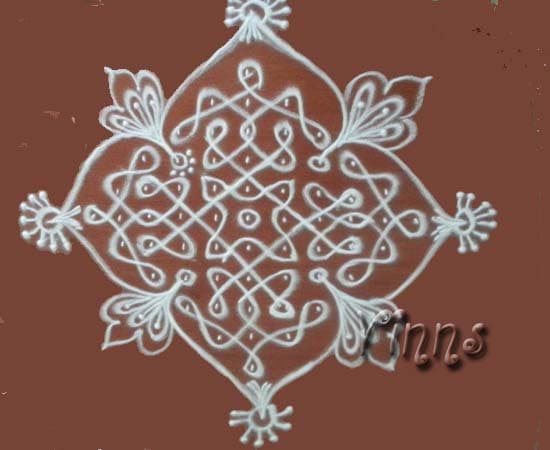
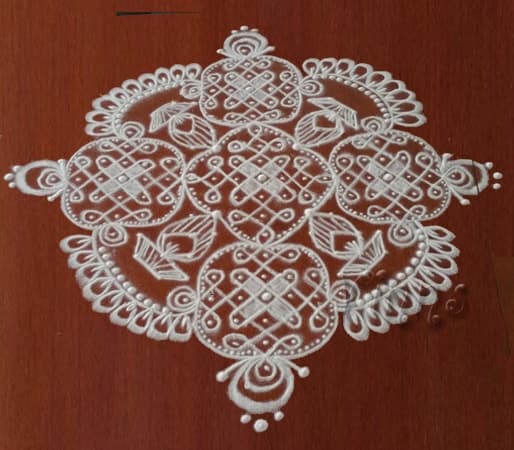
Sikku Kolam (also known as Kambi Kolam or Braided Kolam) is one of the most intellectually revered and mathematically sophisticated traditions of South Indian floor art. Rather than drawing lines that connect dot to dot, the practitioner guides a fluid stream of rice flour around and between the dots, weaving continuous labyrinths that encircle every single point in the matrix.
Topological Harmony & Brahma Mudi
At its highest expression, a Sikku Kolam consists of a single unbroken closed loop (or a set of interlocked symmetrical loops) that returns smoothly to its exact origin. Traditional practitioners refer to certain sacred junctions as Brahma Mudi (the knot of creation). Culturally, leaving no open ends in the loop symbolizes completeness, spiritual infinity, and warding off negative energies from crossing the home threshold.
“In Sikku Kolam, the dot is the celestial anchor; the curve is the breath of life moving around the stillness.”
Technique & Mathematical Symmetry
Sikku patterns are typically constructed on an Idupulli (interlaced dot) or Nerkodu (parallel square) matrix. The drafting requires acute spatial memory, 4-fold radial or rotational symmetry, and steady finger coordination to ensure even flour distribution.